The Prolific Progeny of Priam: A King's Burden
King Priam of Troy, a figure synonymous with the relentless tragedy of the Trojan War, bore a sorrowful destiny etched in the fates of his many children. Accounts vary, but most ancient sources agree that Priam was a father of immense progeny, reportedly having anywhere from 50 to 68 sons and numerous daughters. This vast lineage, primarily stemming from his chief wife Hecuba (daughter of Dymas or Cisseus) and a multitude of concubines, was both a source of Trojan strength and, ultimately, its gravest vulnerability. Each
mythical Trojan prince, a potential leader and defender, became another casualty in the epic struggle against the Achaeans.
The sheer number of Priam's sons meant that his grief was not merely an individual sorrow but a foundational element of Troy's downfall. His family tree, while sprawling, was tragically pruned by the conflict. While there's no single exhaustive list of all his children, Homer's
Iliad, Apollodorus's
Bibliotheca, and Hyginus's
Fabulae provide the most comprehensive, albeit sometimes differing, accounts. These ancient texts paint a vivid picture of a royal house destined for catastrophe, where almost every Priam's son would meet a violent end, often at the hands of the most formidable Greek heroes. This article delves into the individual and collective tragedies that befell these unfortunate princes, illuminating the profound cost of the Trojan War for their royal father.
Heroes and Harbingers of Doom: Priam's Most Famous Sons
Among Priam's extensive brood, several sons rose to prominence, their names forever intertwined with the grandeur and devastation of the Trojan War. Their individual stories are threads in the larger tapestry of Troy's demise, each contributing to the king's profound and unyielding grief.
Hector: Troy's Valiant Shield
No Priam's son looms larger in the epic narrative than
Hector, the undisputed champion of Troy. Born to Queen Hecuba, Hector was the city's heir apparent and its most formidable defender. His courage, sense of duty, and deep love for his family made him a noble adversary to the Greeks. He led the Trojan forces with unparalleled bravery, inflicting heavy losses on the Achaeans and even killing Patroclus, Achilles's beloved companion. However, Hector's fate was sealed by divine decree. In a climactic duel outside the Scaean Gates, he was killed by the enraged Achilles, who then desecrated his body by dragging it behind his chariot around the walls of Troy. This act, perhaps more than any other, symbolized the imminent fall of the city and Priam's ultimate heartbreak, as he watched his greatest son's body abused before his very eyes.
Paris: The Catalyst of Conflict
Another son of Hecuba,
Paris, or Alexandros, was tragically destined to ignite the very war that consumed his family. Raised as a shepherd after a prophecy foretold his destructive influence, his abduction of Helen from Sparta, spurred by Aphrodite's promise, launched a thousand ships and sealed Troy's doom. While not a warrior of Hector's caliber, Paris was a skilled archer, famously felling Achilles with an arrow guided by Apollo. His own end came near the war's conclusion, killed by the poisoned arrow of Philoctetes. Paris's story is a profound exploration of fate and individual responsibility, a
Priam's son whose actions, however unintentional, led to the destruction of his home and the slaughter of his kin.
Deiphobus: A Cunning Prince with a Tragic End
Also a son of Hecuba,
Deiphobus was known for his courage and cunning. After Paris's death, he famously married Helen, perhaps a move of political desperation more than love. His end was brutally fitting for the chaotic sack of Troy. During the final assault, he was slain with particular savagery by Odysseus and Menelaus, the latter driven by a desire for vengeance against Helen's new husband. Some accounts even suggest Helen herself betrayed him.
Helenus and Troilus: Seer and Sacrifice
Helenus, another son of Hecuba, was the twin brother of the prophetess Cassandra and possessed prophetic gifts himself. His unique fate saw him survive the war, a rare exception among Priam's sons. After the fall of Troy, he initially competed with Deiphobus for Helen's hand. He later played a significant role in guiding Aeneas on his journey to found Rome, and even married Andromache, Hector's widow.
In stark contrast to Helenus's survival, young
Troilus represented the ultimate sacrifice of youth and innocence. Often depicted as a beautiful, youthful prince, possibly fathered by Apollo and Hecuba, a prophecy stated that if Troilus reached the age of twenty, Troy would not fall. Tragically, he was ambushed and killed by Achilles, usually depicted as being slain at the altar of Apollo or in a particularly brutal pursuit. His death signaled the inevitability of Troy's defeat and remains one of the most poignant tales of a Priam's son cut down in his prime.
The Lesser-Known Sons: Unsung Sacrifices and Swift Ends
While Hector, Paris, and a few others dominate the narrative, the vast majority of Priam's sons met less glorious, yet equally tragic, ends. These numerous princes, often mentioned fleetingly in the heat of battle, underscore the sheer scale of the Trojan losses and King Priam's immeasurable personal suffering. Each of these fallen men was a
Priam's son, a piece of his heart ripped away by the war.
Many of these sons fought bravely but were ultimately overwhelmed by the superior might and individual prowess of the Achaean heroes.
- Polydorus, the youngest son of Hecuba, was sent away for safety but was later murdered by King Polymestor of Thrace for his gold, a betrayal that compounded Priam's family's sorrows.
- Polites, another son of Hecuba, was killed by Neoptolemus, Achilles's son, during the brutal sack of Troy, often depicted as being slain right before his father's eyes.
- Kebriones, Hector's charioteer, met his end at the hands of Patroclus, struck down by a heavy stone during a fierce engagement.
- Gorgythion, whose mother was Castianeira, was tragically killed by an arrow from Teucer, intended for Hector.
- Mestor, another of Priam's many sons, was listed among those killed by Achilles, highlighting the devastating impact of the Greek hero on the Trojan royal line.
- Other names like Chromius (killed by Diomedes), Doryclus (killed by Ajax), Democoon (killed by Odysseus), and Agathon (who may have been among the last survivors or slain by Ajax the Great) echo through the ancient texts, each a testament to the war's relentless toll.
These lesser-known sons represent the crushing reality of war for a royal family. They were not mere statistics but individuals, each contributing to the defense of their city and each leaving a gaping wound in their father's heart. Their rapid, often brutal, and sometimes anonymous deaths serve to emphasize the overwhelming power of the invading forces and the futility of Troy's desperate resistance.
The Collective Tragedy: A Father's Grief and a City's Fall
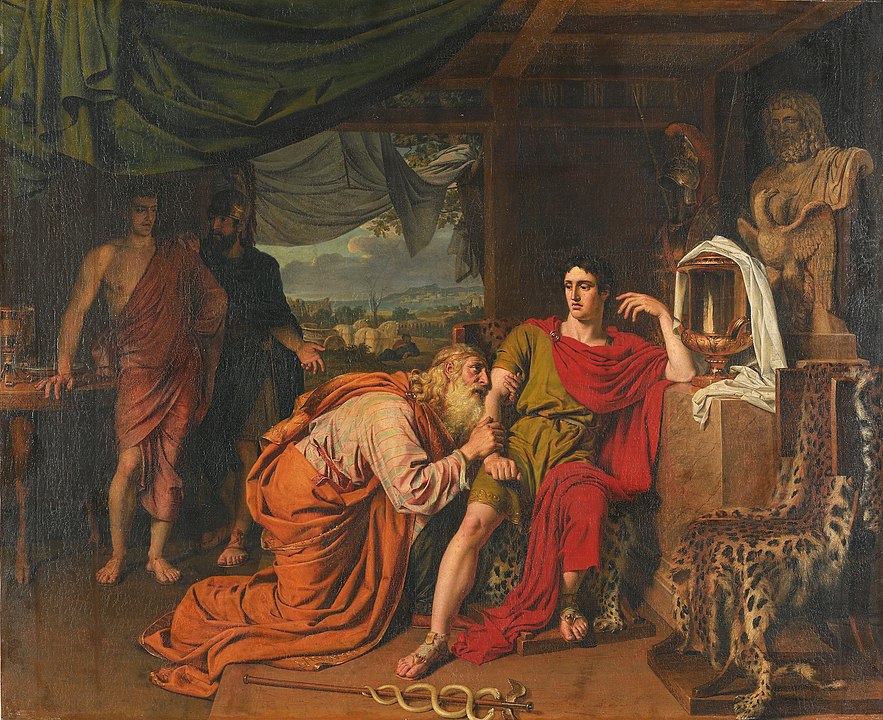
The cumulative effect of so many deaths among Priam's sons is central to the tragedy of the Trojan War. King Priam, a venerable patriarch, was forced to witness the decimation of his lineage, a fate few fathers could endure. His lamentations over Hector's body, and his desperate pleas for its return, are among the most poignant scenes in the
Iliad, capturing the universal anguish of a parent grieving a child.
This profound personal loss mirrored the destruction of his city. Each fallen Priam's son was not just a prince but a defender, a symbol of Troy's vitality. Their deaths chipped away at the city's morale, its military strength, and its very future. The narrative of Priam's sons offers a powerful reflection on the human cost of conflict, illustrating how war rips apart not just nations but the very fabric of families. It teaches us about the enduring nature of grief and the way in which personal sorrow can become inextricably linked with national disaster. The fates of Priam's children are a stark reminder that in war, even victory comes at an incalculable human price.
Conclusion
The story of King Priam's many sons is more than a list of names and tragic ends; it is a profound exploration of duty, destiny, and devastating loss within the crucible of the Trojan War. From the celebrated heroism of Hector to the youthful sacrifice of Troilus, and the countless lesser-known princes who fell, each
Priam's son contributed to the epic narrative of Troy's valiant struggle and ultimate demise. Their collective tragedy underscores the immense personal suffering endured by King Priam and Queen Hecuba, making their grief a timeless symbol of parental sorrow. These tales, meticulously pieced together from ancient sources like Homer, Apollodorus, and Hyginus, continue to resonate, offering timeless insights into the destructive power of war and the enduring human spirit in the face of unimaginable adversity. The memory of Priam's sons ensures that the fall of Troy is remembered not just as a historical event, but as a deeply human tragedy.